
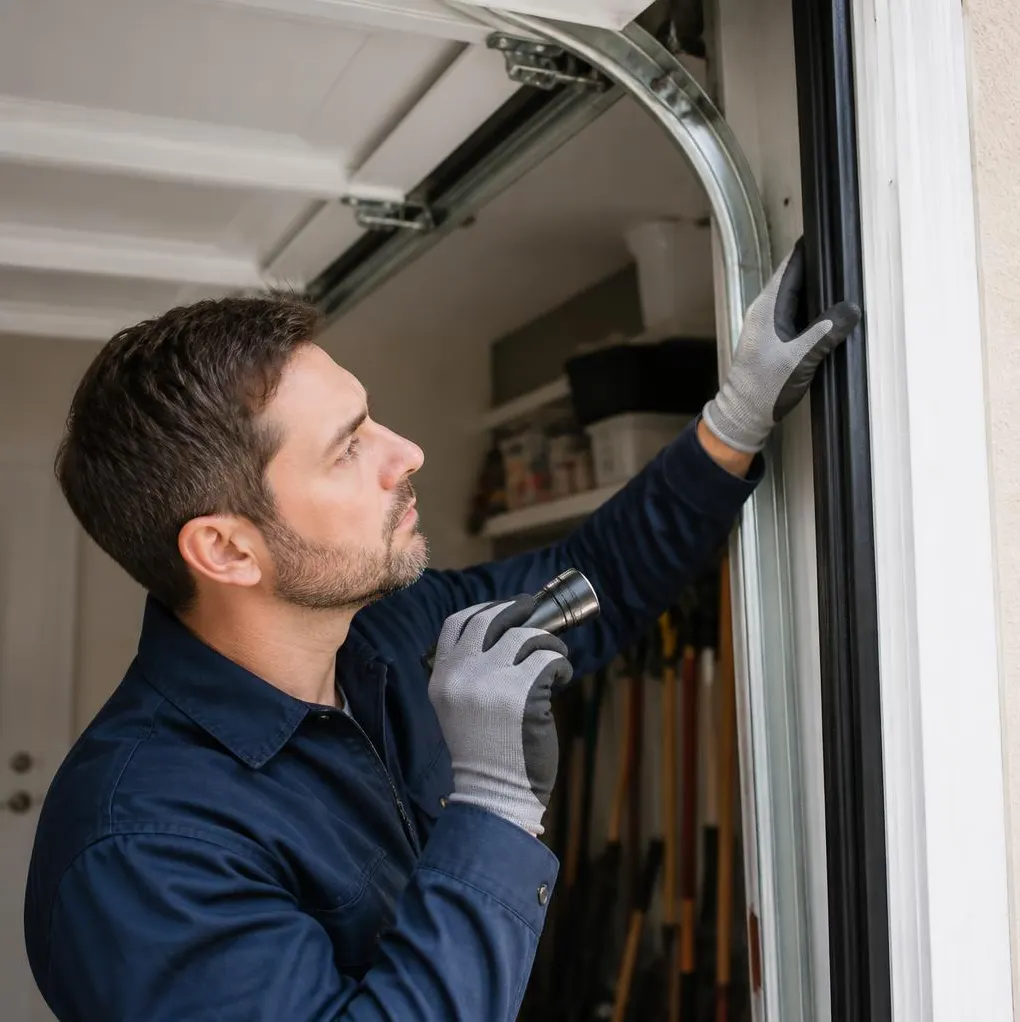
What a Technician Sees After a Storm Rolls Through
After a round of severe weather, the calls we get tend to follow a pattern: a door that looks fine from the driveway but won't seal flush at the bottom anymore, rollers that have popped halfway out of the track, or a panel with a visible bow in the middle like it took a punch. Sometimes it's more obvious — a track bent at an angle where wind pressure pushed the door outward against its hardware. None of this is random. It's what happens when a door built for daily use suddenly has to act as a wind barrier during a storm it was never specifically braced for.
Why the Garage Door Is the Weakest Wall in the House
Every other exterior wall on a house is a fixed, continuous structure. The garage door is a large moving panel held in place by tracks, rollers, and a handful of hinges and brackets. When wind hits a house, it creates pressure on the windward side and suction on the back and roof. A garage door spanning 9 to 16 feet of opening flexes more than a solid wall, and once it flexes enough to pull rollers from the track or crack a panel, wind can push into the garage. That sudden pressure inside the structure is what tends to do real damage — stressing the roof deck and walls from the inside out. A door that holds its shape keeps that pressure where it belongs: outside.
What to Check Before Storm Season Peaks
- Rollers and tracks: Look for rollers that are worn, cracked, or not seated fully in the track. A roller that's already loose has far less margin before it pops out under wind load.
- Track alignment: Stand back and sight down each track. Gaps, bends, or sections pulling away from the wall brackets should be corrected before a storm, not after.
- Panels: Dents or stress cracks weaken a panel's ability to flex and return to shape. A panel that's already compromised is the one most likely to fail first.
- Weatherstripping and bottom seal: Cracked or brittle seals let wind-driven rain push underneath the door, which adds water damage to the list even if the door itself holds.
- Hardware: Hinges, brackets, and lag screws loosen over time with heat cycling and daily use. Tighten what you can reach safely; leave anything involving spring tension to a professional.
- Opener battery backup: High wind and storms often come with power outages. A working battery backup means you can still close and secure the door manually or electrically if the power drops mid-storm.
Reinforcement Options Worth Knowing
If your garage faces the direction storms typically come from, or the door is older and single-layer, a few upgrades are worth weighing against the cost of storm damage later:
- Horizontal bracing kits add rigidity to an existing door panel and are a lower-cost way to improve wind resistance without full replacement.
- Wind-rated or impact-resistant doors are built with reinforced panels and stronger track systems designed specifically to resist higher wind pressures. These run a wider range nationally, generally a few hundred to a couple thousand dollars more than a standard door depending on size and materials.
- Heavier-gauge tracks and reinforced end hinges give the door more to hold onto when wind pressure builds, reducing the chance of the track pulling away from the wall.
After the Storm: A Quick Walkthrough
Once the weather clears, walk the door through a full open-and-close cycle before assuming it's fine. Listen for grinding, watch for uneven movement on one side, and check whether the door seats flush at the bottom. Hail and wind-driven debris can also dent panels or chip paint in ways that trap moisture and lead to rust over time, so a visual check matters even if the door still operates.
When to Call Crosby Garage Door
If a door won't close all the way, a track looks bent, or a storm has left a spring sounding different than usual, that's the point to call rather than keep testing it yourself — a damaged door under tension is one of the more dangerous DIY repairs in a house. Our garage door repair technicians can diagnose whether it's a track, roller, or spring issue, and our spring replacement service handles the parts under the most physical stress. For homes that see repeat storm exposure, we also walk through reinforcement and garage door maintenance options so the door is less likely to fail the next time wind picks up.
If you're in Crosby, Huffman, Baytown, Highlands, Mont Belvieu, Atascocita, Barrett, or Dayton and want your garage door checked before the next storm rolls through, call Crosby Garage Door — we show up on time and get it done right.